
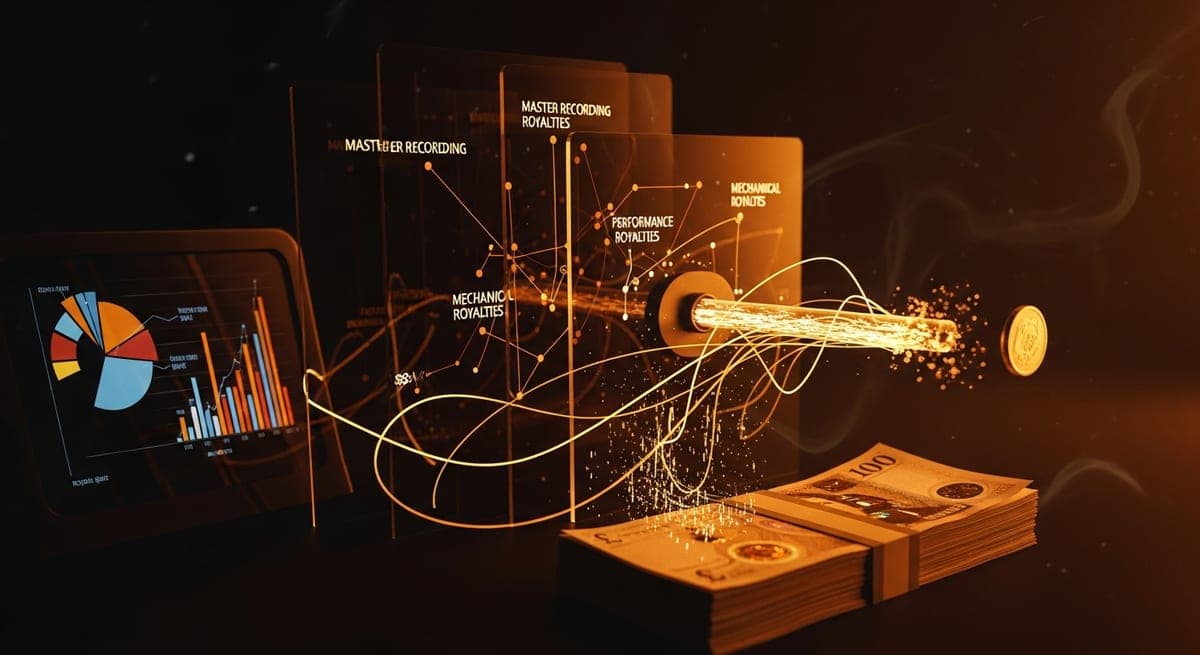
One stream, multiple royalties
When your music is streamed on Spotify, Apple Music, or any other DSP, it generates more than one royalty payment. Most artists are aware of the recording royalty, which is the income paid to the owner of the master recording that flows through your distributor. Fewer are aware that the same stream also generates a performance royalty and a mechanical royalty for the underlying composition. These are separate payments, collected through separate organisations, and they require separate registrations to receive. Missing either of the composition royalties means collecting roughly half of what you are owed from each stream.
Recording royalties: what they are and how they are paid
The recording royalty is the income generated by the master recording being streamed. The streaming platform reports play data to your distributor, which calculates your share of the royalty pool and pays you on a monthly or quarterly basis. The recording royalty is typically the largest single component of your streaming income. For a self-releasing independent artist who owns their masters, 100% of the recording royalty income belongs to you; there is no label split to account for.
Performance royalties from streaming
Every stream also constitutes a public communication of the underlying composition: the song itself, independent of the recording. This generates a performance royalty collected by PRS for Music on behalf of the songwriter and composer. Spotify, Apple Music, and other DSPs pay PRS a licence fee, and PRS distributes this income to its members based on streaming usage data. To receive this royalty, your composition must be registered with PRS and the work must correctly match the ISRC reported by the platform.
Mechanical royalties from streaming
Streaming also generates a mechanical royalty: income arising from the digital reproduction of the composition that occurs when a track is buffered or downloaded for offline playback. In the UK, MCPS (operating under the PRS for Music umbrella) collects these mechanical royalties from streaming platforms and distributes them to rights holders. The mechanical royalty from streaming is typically smaller than the performance royalty but is a real and collectible income stream that many independent artists miss entirely.
Neighbouring rights: the recording royalty that most artists miss
In addition to the master recording royalty paid through your distributor, there is a separate neighbouring rights royalty for recordings played on certain platforms and in public spaces. PPL (Phonographic Performance Limited) collects these royalties in the UK on behalf of performers and record labels. For artists who perform on their own recordings, PPL membership provides access to this additional income stream. It is separate from both the distributor recording royalty and the PRS composition royalties.
The four separate income streams from one stream
To summarise, a single stream of your self-released track can generate four separate royalty payments:
- Recording royalty: paid to you as master owner, via your distributor
- Performance royalty: paid to you as songwriter, via PRS for Music
- Mechanical royalty: paid to you as songwriter, via MCPS
- Neighbouring rights: paid to you as performer, via PPL
Why most artists only receive one
The recording royalty requires only a distributor. The three remaining streams each require separate registrations: PRS membership and works registration for performance royalties, MCPS registration for mechanical royalties, and PPL membership for neighbouring rights. Most independent artists have a distributor but have not completed all three additional registrations. As a result, each stream generates four royalties but the artist collects only one.
If you are unsure how many of these four income streams you are currently receiving, our free Catalog Assessment will tell you exactly where you stand and what registrations are missing.
Frequently Asked Questions
How many royalties does one stream generate in the UK?
A single stream of a self-released track can generate four separate royalty payments - a recording royalty via your distributor, a performance royalty via PRS for Music, a mechanical royalty via MCPS, and neighbouring rights via PPL. Each is collected through a separate organisation and requires its own registration.
Do I get performance royalties from Spotify streams?
Yes. Every stream constitutes a public communication of the underlying composition, which generates a performance royalty collected by PRS for Music. To receive it, your composition must be registered with PRS and the work must correctly match the ISRC reported by the platform.
Why am I only getting paid by my distributor?
The recording royalty is the only one of the four streaming income streams that requires nothing beyond a distributor. The other three each need separate registrations - PRS membership and works registration, MCPS registration, and PPL membership. Most independent artists have a distributor but have not completed all three, so they collect only one royalty per stream.
What are mechanical royalties from streaming?
Streaming generates a mechanical royalty from the digital reproduction of the composition that occurs when a track is buffered or downloaded for offline playback. In the UK, MCPS collects these from streaming platforms. It is typically smaller than the performance royalty but is a real, collectible income stream that many independent artists miss.
Published · Updated