
Why the choice of distributor matters more than most artists realise
Digital distribution is the mechanism that puts your music on Spotify, Apple Music, Amazon Music, Tidal, and 150+ other platforms globally. Most artists treat it as a commodity, a simple upload pipeline, and choose on price. That is a mistake. The quality of your distributor affects your metadata accuracy, your royalty collection completeness, your reporting transparency, and your ability to pitch for editorial placement. Choosing the cheapest option often costs more in uncollected royalties than it saves in fees.
Ownership: the most important clause in any distribution agreement
Some distribution services, particularly at the lower price tier, include language that grants them a licence to your master recordings as a condition of distribution. This is distinct from actual ownership transfer, but it can restrict your ability to switch distributors, reclaim your catalog, or negotiate other deals. Always read the ownership and termination clauses carefully. A legitimate distribution service should never acquire any ownership interest in your recordings as part of a standard distribution agreement.
What to evaluate when comparing distributors
Beyond price, these are the factors that actually determine the quality of a distribution service:
- Platform coverage: are all major DSPs included, or is the list curated to the most popular ones only?
- Metadata standards: does the distributor follow DDEX standards and correctly issue ISRC codes?
- Royalty reporting: are statements itemised by platform and territory, or are they aggregated lump sums?
- Payment frequency and threshold: monthly payments with a low withdrawal threshold are standard; watch for quarterly payment cycles or high minimum thresholds
- Editorial pitching: does the distributor submit your releases to DSP editorial teams, and with what lead time?
- Publishing administration: does the distributor also collect your composition royalties, or just your recording royalties?
- Support quality: can you reach a real person when something goes wrong with a release?
The annual fee trap
Several distribution services charge a low annual fee (sometimes as little as £20 per year) and market this as keeping 100% of your royalties. This sounds straightforward, but the fine print often includes deductions for currency conversion, payment processing, or minimum thresholds that erode what you actually receive. Some services also charge additional fees for priority distribution, playlist pitching, or ISRC issuance that are included as standard with a proper distribution partner.
The royalty split model: what it means
An alternative to the annual fee model is a royalty split, where the distributor retains a percentage (typically 10–20%) of your streaming revenue and pays you the remainder. For emerging artists with modest streaming numbers, an annual fee model will often be cheaper in absolute terms. For artists generating consistent streaming income, a percentage model quickly costs more than a flat fee. Understand which model you are on and whether it aligns with your current stage.
Distribution and publishing: why they are separate
Digital distribution handles your recording royalties: the money earned by your masters when they are streamed or downloaded. It does not handle your publishing royalties: the money earned by your compositions when they are performed, broadcast, or used in sync. These are two separate income streams, collected through two separate systems. A complete setup requires both a distribution partner for your recordings and a publishing administration arrangement for your compositions. Many independent artists only have the first half in place.
The UK and global DSP landscape in 2026
The streaming platform landscape is not uniform. Each DSP has a distinct audience profile, payout structure, and editorial culture. UK artists should understand the landscape before choosing a distributor, because not all distributors cover every platform, and the gaps matter. The major Western DSPs are well known, but the platforms below each have distinct characteristics that affect both income and audience reach.
- Spotify: the dominant UK streaming platform, accounting for roughly 55% of domestic streaming market share. Offers editorial playlist pitching via Spotify for Artists, algorithmic placement through Release Radar and Discover Weekly, and Canvas video loop support.
- Apple Music: premium positioning with a subscriber-only model. Per-stream rates are historically higher than Spotify and the editorial team has a strong track record of breaking UK artists internationally.
- Amazon Music: growth driven by Prime bundle inclusion. Increasingly important for catalogue discovery, particularly in the pop and classical segments. Alexa integration creates a separate voice-search discovery channel that rewards clean metadata.
- YouTube Music: global reach at lower per-stream rates. Your music also appears on standard YouTube via Content ID, which generates ad revenue from user-generated content that includes your recordings. A distributor that does not register your releases with Content ID is leaving money uncollected.
- Tidal: smaller subscriber base but a quality-focused audience and artist-friendly royalty model. Historically pays above-average rates.
- Deezer: strongest in continental Europe, particularly France, Brazil, and francophone Africa. Worth covering if you have any European audience.
- TikTok SoundOn: creator platform with viral potential. A track that gains traction on TikTok reliably converts to Spotify streams. Your distributor should cover TikTok as a separate delivery destination.
Emerging global markets
UK artists with growing international audiences should also consider coverage of Boomplay (dominant in sub-Saharan Africa, particularly Nigeria, Ghana, and Kenya), Yandex Music (Russia and Russian-speaking markets), and JOOX (Southeast Asia, particularly Thailand, Malaysia, and Indonesia). These markets are individually small but add up across a career. Bandcamp remains the most effective direct-to-fan sales channel for physical and digital sales outside the streaming model, and a distributor's Bandcamp integration (or lack of it) is worth checking.
How streaming royalties are calculated
Most artists have a rough sense that streaming pays very little per play, but fewer understand why the per-stream rate fluctuates and what determines how much a given stream is worth. The mechanism is a pro-rata pool model. Each DSP accumulates total subscription and advertising revenue in a given month, deducts its operating margin, and distributes the remainder as a royalty pool across all rights holders in proportion to their share of total streams. The formula is effectively total pool divided by total streams, multiplied by your stream count. Because the pool size and the total stream count both fluctuate monthly, your effective per-stream rate is never fixed. Spotify's effective UK rate has historically ranged between £0.002 and £0.004 per stream; Apple Music typically yields £0.006–£0.009.
What affects the value of a stream
Not all streams carry equal weight. Premium subscriber streams pay more than free-tier ad-supported streams on the same platform. Streams from markets with higher subscription prices generate more royalty value - a stream from a Norwegian subscriber is worth materially more than a stream from a Brazilian subscriber, because the Norwegian subscription price is higher and contributes proportionally more to the pool. This is why your royalty statement should always show territory-level breakdowns. An aggregated global figure is not actionable - it hides which markets are performing and which are not.
ISRC codes and your distributor's responsibility
An ISRC (International Standard Recording Code) is the unique identifier assigned to each individual recording. Every commercially released recording should have one. ISRCs are not optional infrastructure - they are the mechanism by which DSPs, collection societies, and rights databases route royalty payments to the correct rights holder.
Why ISRCs matter beyond basic distribution
A correctly issued and embedded ISRC links your recording to DSP payment routing and simultaneously connects it to PRS for Music and MCPS composition rights data. This linkage is what enables mechanical royalty payments to flow on top of streaming royalties - the composition rights income that most independent artists are under-collecting. A recording without a properly embedded ISRC can appear on a DSP and generate streams while its composition royalties go unclaimed, because the collection society cannot match the stream data to the correct work registration.
Common ISRC failure modes
Wrong ISRCs (mistyped or auto-generated incorrectly), duplicate ISRCs (the same code applied to two different recordings), and missing ISRCs (recordings delivered without any code) all cause royalty routing failures. Your distributor is responsible for issuing ISRCs if you do not already hold them. Critically, ISRCs belong to your catalog permanently and should travel with the recording regardless of which distributor or label relationship holds them at any given time. Always document every ISRC issued against your releases in a master catalog spreadsheet, independent of any distributor portal. If your distributor closes or you leave their platform, you need those codes.
What happens when you switch distributors
Switching distribution partner is more complex than most artists anticipate, and the complexity is almost entirely concentrated in one issue - ISRC continuity. When you deliver a recording to a DSP, that DSP indexes it by ISRC. If you switch distributors and the new distributor issues a new ISRC for the same recording - either through error or deliberate policy - the DSP treats it as an entirely new release. Stream counts reset to zero. Playlist placements (algorithmic and editorial) are lost. Any momentum you had built on that recording is erased from the platform's perspective.
How to switch distributors safely
Before initiating a switch, confirm in writing from your current distributor that all existing ISRCs will transfer with your catalog, or obtain a complete ISRC documentation list for every release you have distributed through them. Some distributors are cooperative about this process; others create friction or deny access to ISRC data. A distributor that makes it difficult to retrieve your own ISRC records is itself a significant red flag. The transition process typically involves taking releases down from the current distributor, waiting for DSP takedowns to process (which can take several weeks), and then redelivering with the new distributor using the same ISRCs. Plan for a gap in streaming availability and build that into any release or campaign timeline.
Pre-save campaigns and first-week strategy
A pre-save allows fans to add your upcoming release to their Spotify library or Apple Music collection before the public release date. When the release goes live, it automatically appears in those fans' libraries - creating a first-day streaming spike that the platform's algorithms read as a momentum signal. Spotify's algorithm treats high first-day and first-week stream activity as a positive signal for Release Radar and Discover Weekly placement. Release Radar is a personalised playlist served to fans who have saved your artist profile; Discover Weekly surfaces your music to new listeners who have not heard you before. Both placements are driven substantially by early release performance. A coordinated pre-save campaign that drives activity into day one is therefore not just a fan engagement tactic - it is an algorithmic lever.
Practical requirements for a pre-save campaign
A pre-save campaign requires your release to be delivered to DSPs before the campaign goes live. The minimum delivery lead time for a coordinated campaign is approximately two weeks, but three to four weeks is the standard for a campaign that includes editorial pitching alongside pre-save. Pre-save links can be built through tools such as SubmitHub, Toneden, or your distributor's own campaign tools. Apple Music, Tidal, and Amazon Music all support equivalent pre-add functionality. A fixed, simultaneous release date across all platforms - rather than a phased rollout - maximises the first-week streaming concentration that algorithms reward.
Editorial playlist pitching
Getting your music onto a Spotify or Apple Music editorial playlist is among the highest-leverage outcomes available in independent distribution. New Music Friday, Fresh Finds, A-List Hip-Hop, Mellow Bars, and thousands of other curated playlists are built and maintained by DSP editorial teams, and placement in even a mid-tier editorial playlist can deliver tens of thousands of streams in a short window.
How Spotify editorial pitching works
Spotify allows distributors and artists to pitch unreleased music directly to the editorial team through Spotify for Artists. The pitch window opens once a release is delivered and closes at the public release date. Pitching must be completed before release - editorial teams do not consider music that is already live. The pitch form asks for genre, sub-genre, mood, language, instrumentation, cultural context, and a brief statement from the artist about the record. Spotify reviews every submission, though the majority do not receive placement. The critical point is that unsubmitted tracks can never receive editorial placement - if your distributor does not support the pitch workflow or does not prompt you to submit, that is a material gap in the service you are receiving.
Apple Music editorial
Apple Music's editorial process works through your distributor or label relationship. Apple does not offer a self-service pitch portal in the same way as Spotify. Editorial consideration is influenced by cultural context, musical quality, and the strength of your distributor's relationship with the Apple editorial team. This is one of the areas where the quality of your distribution partner - and their active engagement with DSP editorial contacts - directly affects commercial outcomes in a way that price comparison alone will never reveal.
Reading your distribution royalty statement
A royalty statement from your distributor is a document you should be able to use for catalog management decisions, not just accounting. If you cannot derive actionable information from your statement, the statement is inadequate. A properly itemised statement shows the platform name, the territory (country) of each stream, the number of streams in that territory for that period, the per-stream rate applied, the source currency, any currency conversion applied, and the resulting GBP amount. It should be filterable by release and by track, so you can see the performance of individual recordings across platforms and markets.
Common statement deficiencies to watch for
- Aggregated lump-sum figures with no platform or territory breakdown are inadequate for catalog management. You cannot identify which markets are growing or which platforms are under-performing.
- Currency conversion charges applied by the distributor on top of the interbank exchange rate are a common hidden fee. Check whether the rate applied in your statement matches the prevailing rate for the payment date.
- Minimum payment thresholds that hold earnings below a certain balance amount to an interest-free loan to the distributor. Understand the threshold and factor it into cash-flow planning.
- Discrepancies between what a platform's own artist dashboard reports and what the distributor passes through warrant a written query. Some distributors retain a margin on currency conversion that does not appear as an explicit line item.
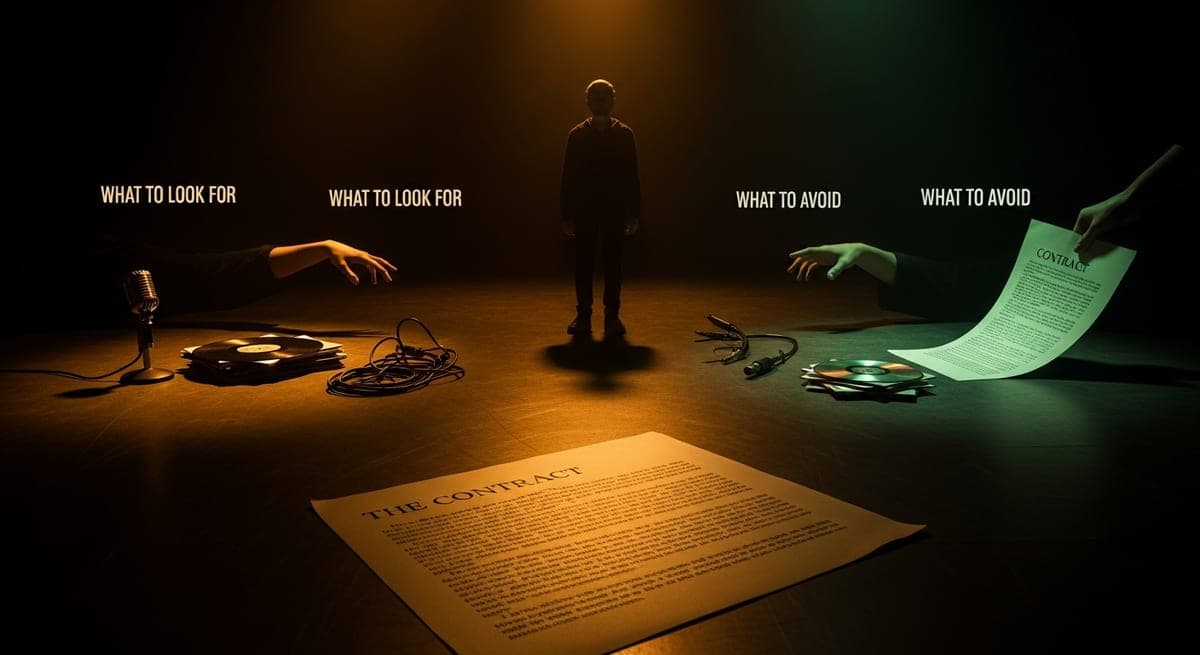
Red flags in a distribution contract
The following clauses, if present in a distribution agreement, warrant careful scrutiny or outright rejection. None of them appear in the agreements of reputable distribution partners.
- Perpetual licence language: the agreement should terminate when you leave and your catalog should revert fully to your control. Rights granted 'in perpetuity' create an obligation that survives termination.
- Ownership language: no distribution agreement should acquire any ownership interest in your recordings. Distribution is a service, not a rights acquisition. Any language that conflates the two is a fundamental problem.
- Re-recording restrictions: some contracts prevent you from re-recording songs covered by the agreement for a defined period. This is a label deal clause that has no legitimate place in a distribution agreement.
- Most-favoured-nation clauses: may prevent you from distributing the same recording through another channel or as part of a sync deal without explicit distributor consent. Check the scope carefully.
- Unclear termination provisions: you must know the notice period required to terminate, what happens to your releases during the notice period, and how long DSP takedowns are expected to take. Vague language here creates practical leverage for the distributor.
- Sub-licensing rights: confirm whether the distributor can sub-license your recordings to third parties - for example, to another aggregator or a sync licensing platform - without your explicit prior consent for each deal.
If you are evaluating your current distribution setup or considering a switch, our Catalog Assessment covers both sides of the income picture (recordings and compositions) and we will tell you honestly where gaps exist.
Frequently Asked Questions
How long does it take for music to appear on streaming platforms?
Most major distributors deliver to Spotify and Apple Music within 3–7 business days of submission. Some offer priority delivery for an additional fee. Allow at least two weeks from submission to planned release date, especially for a first release where your distributor account is being verified. Certain platforms - Amazon Music and Tidal in particular - may take longer than Spotify and Apple Music. YouTube Music typically ingests new releases within 24 hours once the main platforms have accepted delivery. As a practical rule, plan your release date around a four-week delivery lead time if you want any room for editorial pitching or pre-save campaign activity before the release goes live.
Can I release the same recording through multiple distributors?
No. Each recording should only be active with one distributor at a time. Distributing the same ISRC through two distributors simultaneously creates duplicate listings on DSPs and can cause royalty routing conflicts, with payment potentially split incorrectly between two distributor accounts. If you want to move distributors, you must take the recording down with your current distributor (or let the agreement terminate) before delivering it through a new one. There is typically a gap in platform availability during this process - plan for it rather than trying to avoid it.
Do I need a distributor if I already have a record deal?
If you are signed to a label, the label typically handles distribution as part of the deal. However, if you are releasing music independently outside your deal - b-sides, side projects, or releases after your deal term expires - you will need your own distribution arrangement. Check your label agreement carefully before releasing anything independently. Some deals include provisions about independent releases during the term, right of first refusal on new material, or restrictions on competing releases. Releasing independently during an active label deal without checking the contract is a common and costly mistake.
What is the difference between digital distribution and physical distribution?
Digital distribution delivers your recordings to streaming platforms and digital download stores. Physical distribution handles the manufacturing and retail sale of CDs, vinyl, and cassettes. Most distributors focus on digital only; some offer physical distribution as an add-on service, typically through a third-party fulfilment partner. For independent artists, physical distribution only makes commercial sense if you have a proven physical sales base - tour merchandise sales, Bandcamp direct sales, or an established retail relationship. The logistics cost of manufacturing unsold stock, warehousing it, and managing returns from retailers can significantly exceed the revenue generated if the physical demand is not already demonstrated.
How do I keep 100% of my streaming royalties?
The phrase "keep 100% of your royalties" in distributor marketing refers specifically to recording royalties - the income generated by streams and downloads of your master recordings. Even on a fee model where the distributor takes no revenue share, your composition royalties require separate registration and collection through PRS for Music and an appropriate publishing administration arrangement. No distribution agreement, regardless of the royalty model, handles composition royalties automatically. An artist who is keeping 100% of their recording royalties but has no publishing administration in place is still leaving a material share of their total music income uncollected.
Published · Updated