
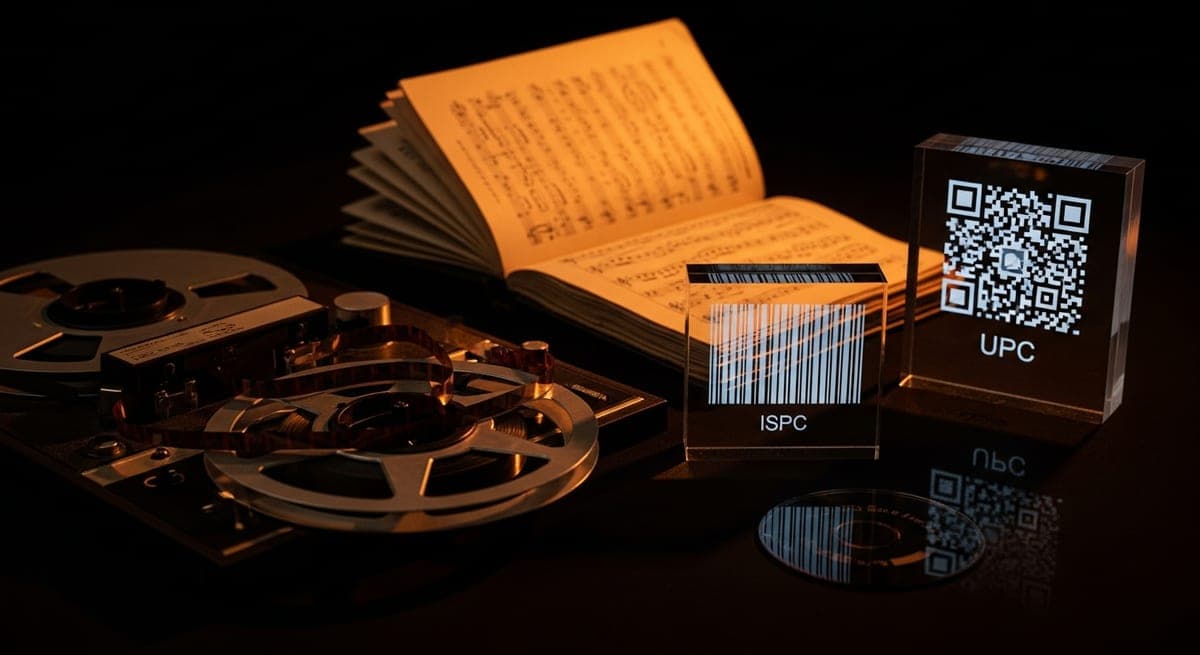
Three codes, three different things
When artists encounter ISRC, ISWC, and UPC codes, they often treat them as variations of the same thing. They are not. Each code identifies a different layer of your music, and each plays a different role in ensuring royalties are correctly attributed and paid. Missing or incorrect codes at any layer creates gaps in the royalty chain. Understanding what each one does is the first step to ensuring your catalog is correctly identified.
ISRC: identifies the recording
An ISRC (International Standard Recording Code) is assigned to a specific sound recording. It is a 12-character code that uniquely identifies the master recording: the specific performance and production captured on a particular track. Every commercially released recording should have a unique ISRC. The ISRC is used by streaming platforms to identify which recording was played, and by neighbouring rights societies (PPL in the UK) to attribute playback royalties to the correct recording owner.
ISWC: identifies the composition
An ISWC (International Standard Musical Work Code) is assigned to the underlying musical composition: the melody, lyrics, and harmonic structure of the song, independent of any recording. One composition has one ISWC, regardless of how many recordings exist. The ISWC is used by PROs (PRS in the UK) to identify the work being performed and attribute performance and mechanical royalties to the correct songwriter and publisher. It is the link between a streaming report and a royalty payment to the writer.
UPC: identifies the release
A UPC (Universal Product Code) identifies a product release: an album, EP, or single as a commercial product. It is the music industry equivalent of the barcode on a physical product. Distributors use UPCs to identify releases in their system and across retail partners. A UPC covers all the tracks on a release collectively, while each individual track on that release carries its own ISRC. UPCs are assigned by distributors or can be obtained directly from GS1 (the organisation that manages the standard).
How the three codes work together
Consider a single-track release:
- UPC: identifies the release product as a whole (the single)
- ISRC: identifies the specific recording contained in that release
- ISWC: identifies the underlying composition that the recording is based on
The royalty flow
When a streaming platform plays the track, it reports the ISRC to the relevant neighbouring rights society and uses the ISRC to attribute the recording royalty. The platform also reports to PROs using the ISRC, which the PRO maps to the ISWC to identify the composition and calculate the publishing royalty. If any link in this chain is broken (ISRC missing, ISWC missing, or the mapping between them absent) royalties go unattributed at that layer.
Common errors involving these codes
The most frequent errors we encounter are: tracks distributed without ISRCs, or with ISRCs assigned by a distributor but never registered with PPL; compositions registered with PRS but without ISWCs, preventing international matching; and ISRC-to-ISWC mapping errors where the recording and composition registrations are not correctly linked. Each of these creates a specific, identifiable gap in royalty collection.
How to audit your codes
A basic audit involves three checks: confirm every released track has a correctly formatted and registered ISRC (via your distributor and PPL portal); confirm every composition has an ISWC (via your PRS portal); and confirm that releases have correctly assigned UPCs (via your distributor). Discrepancies or missing codes should be corrected before distributions accumulate against unregistered works.
If you are unsure whether all three layers of identification are correctly in place for your catalog, our free Catalog Assessment will identify any missing codes and outline the steps to resolve them.
Frequently Asked Questions
What is the difference between an ISRC and an ISWC?
An ISRC identifies a specific sound recording - the particular performance and production captured on a track - while an ISWC identifies the underlying composition, independent of any recording. One composition has one ISWC regardless of how many recordings of it exist, but every commercially released recording should have its own unique ISRC.
Do I need a UPC for a single?
Yes. A UPC identifies the release as a commercial product, whether it is an album, EP or single, and distributors use it to identify the release across retail partners. The track on the single still carries its own ISRC - the UPC covers the release, the ISRC covers the recording inside it.
Who assigns ISRC, ISWC and UPC codes?
ISRCs are typically assigned by your distributor and should be registered with PPL in the UK. ISWCs are assigned when you register your composition with a PRO such as PRS. UPCs are assigned by distributors or can be obtained directly from GS1, the organisation that manages the standard.
What happens if one of these codes is missing from my release?
Royalties go unattributed at the layer where the code is missing. A missing ISRC means playback royalties cannot be matched to the recording, a missing ISWC prevents performance and mechanical royalties reaching the writer, and a broken ISRC-to-ISWC mapping breaks the link between the streaming report and the composition. Our free Catalog Assessment identifies these gaps.
Is a UPC the same as an EAN barcode?
They do the same job in different regions. A UPC is twelve or thirteen digits and originated in North America; the EAN (European Article Number), the equivalent standard used in the UK and Europe, is thirteen digits. Distributors and GS1 handle the conversion between the two automatically, so you do not need to obtain both.
Published · Updated