
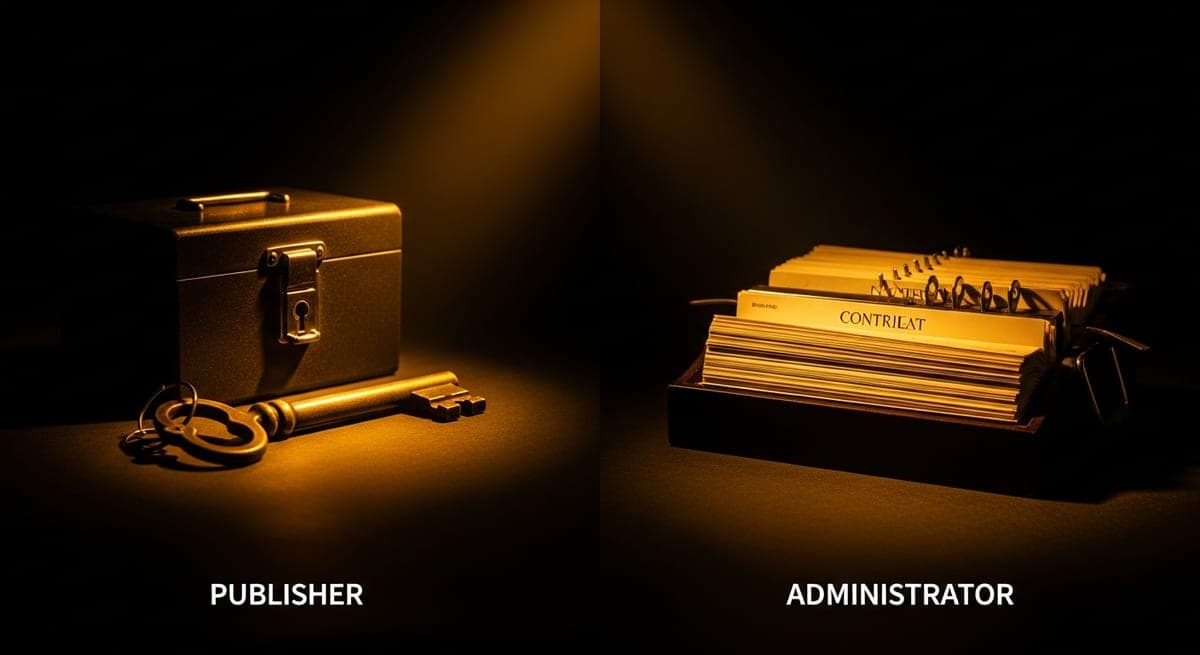
The fundamental difference
Both a music publisher and a publishing administrator help you collect and manage the royalties generated by your compositions. The critical difference is in the ownership exchange. A traditional music publisher acquires a percentage of your copyright (your publishing rights) in exchange for their services. A publishing administrator does not. They administer your catalog on your behalf, collect the royalties you are owed, and charge an administration fee. Your copyright remains entirely yours.
What a traditional music publisher does
A traditional music publisher takes on a portion of your publishing rights, typically 25–50% of the copyright, and in return provides active services including:
- Royalty collection across all territories and income streams
- Sync licensing: pitching your music to film, TV, advertising, and games
- Creative development: sometimes co-writing, A&R, and artist development
- Sub-publishing deals: appointing local publishers in foreign territories to maximise collection
- Catalogue exploitation: seeking out licensing opportunities and new uses for your existing music
What a publishing administrator does
A publishing administrator handles the administrative and collection side of publishing without acquiring any rights. This includes registering your works with collection societies, managing multi-territory registrations, collecting mechanical and performance royalties across all income streams, and auditing your accounts. What it typically does not include is proactive sync pitching or creative development, though some administrators offer these as separate services.
The copyright ownership question
Copyright ownership matters in two practical ways. First, a publisher who owns a share of your copyright has a say in how that music can be used: sync deals, samples, covers. Second, the value of your catalog as an asset is directly tied to how much of it you own. If you have assigned 50% of your publishing to a traditional publisher, 50% of your catalog's future value belongs to them. Many artists who did not understand this at the time of signing have found it difficult or expensive to reclaim their rights.
Reversion clauses and term
Most publishing agreements have a term (a period during which the publisher controls your rights) followed by a reversion clause that can return rights to you if certain conditions are met, or at the end of the term. These clauses vary widely in their specifics and are a critical point of negotiation. A publishing administration agreement, by contrast, typically has a shorter term and no copyright assignment, making it easier to exit if the relationship is not working.
Who needs a publisher and who needs an administrator
A traditional publishing deal makes most sense for artists at a stage where active sync pitching, creative collaboration, and significant catalog development would genuinely benefit their career, and where the rights exchange is a reasonable trade-off for those services. A publishing administrator makes sense for any artist who is generating royalties and wants to ensure they are being correctly collected, without giving up copyright ownership. For most independent artists, a publishing administrator is the appropriate starting point.
The admin commission structure
Publishing administrators typically charge a commission of 10–20% of the royalties they collect, with no upfront fees. This aligns their incentive with yours; they earn more by collecting more. A traditional publisher's income comes from their ownership share of your copyright, meaning they retain their portion regardless of how actively they pursue your royalties.
If you are currently unrepresented and want to understand what publishing administration would mean for your specific catalog, our free Catalog Assessment is the starting point; no sales pitch, just a clear picture of where your royalties currently stand.
Frequently Asked Questions
What is the difference between a music publisher and a publishing administrator?
A traditional music publisher acquires a percentage of your copyright, typically 25-50%, in exchange for its services. A publishing administrator does not - it administers your catalog on your behalf, collects the royalties you are owed, and charges an administration fee while your copyright remains entirely yours.
Does a publishing administrator own any of my songs?
No. An administrator registers your works with collection societies, manages multi-territory registrations, collects mechanical and performance royalties, and audits your accounts without acquiring any rights. That makes an administration agreement easier to exit than a publishing deal, which involves a copyright assignment and a longer term.
How much does a publishing administrator charge?
Publishing administrators typically charge a commission of 10-20% of the royalties they collect, with no upfront fees. This aligns their incentive with yours - they earn more by collecting more. Code Group Music's free Catalog Assessment is the starting point for understanding what administration would mean for your catalog.
Should an independent artist sign with a publisher or an administrator?
For most independent artists, a publishing administrator is the appropriate starting point - it ensures royalties are correctly collected without giving up copyright ownership. A traditional publishing deal makes most sense when active sync pitching, creative collaboration, and catalog development would genuinely benefit your career enough to justify the rights exchange.
Published · Updated