
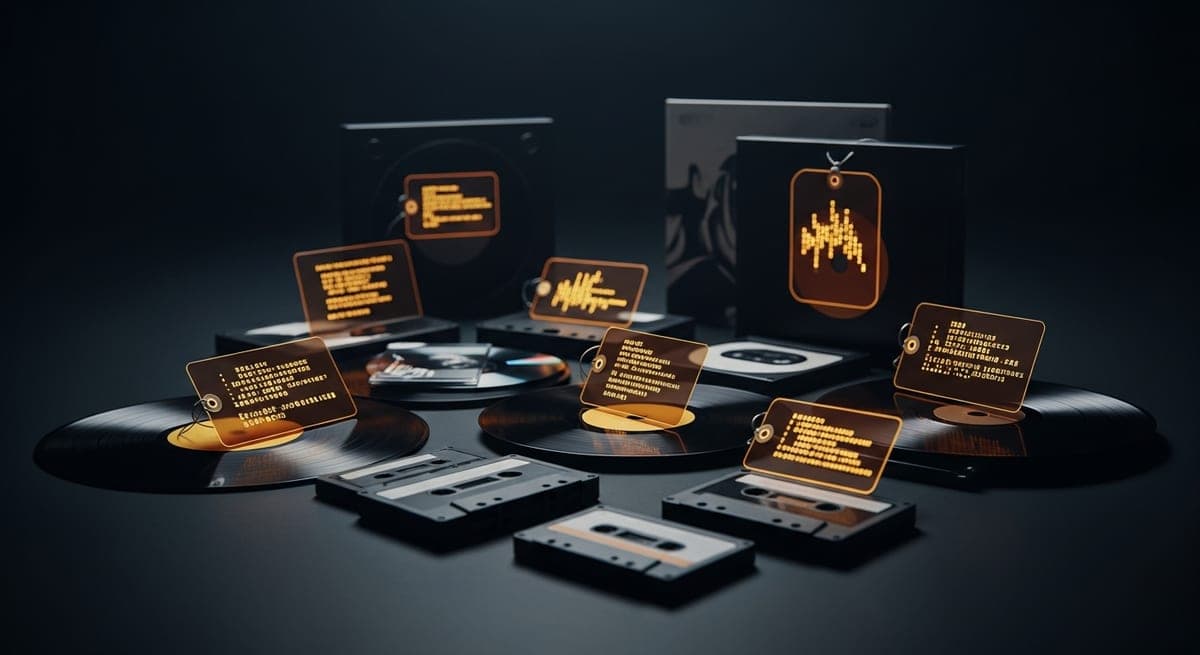
What is music metadata?
Metadata, in any context, is data that describes other data. In music, metadata is the structured information attached to a recording or composition that identifies it, attributes it to its creators, and enables it to be tracked through commercial systems. When a track is streamed on Spotify, broadcast on BBC Radio 1, or licensed in a film, the systems handling that usage rely entirely on metadata to determine who owns the rights and where the payment should go. Without accurate metadata, the track is effectively anonymous to the machines that process royalties; anonymous tracks do not get paid.
The two layers of music metadata
There are two distinct layers of metadata, corresponding to the two distinct rights in any commercially released song. Recording metadata identifies the master recording: the specific audio file that was released. It includes the ISRC, the performing artist name, the release date, the record label, the UPC, the duration, and the audio file format. Composition metadata identifies the underlying song: the words and music. It includes the ISWC, the songwriter names, the publisher name, the ownership splits, and the language. Both layers must be complete and accurate for royalties to flow correctly. A recording with a perfect ISRC but a missing ISWC will collect recording royalties but miss composition royalties. An ISWC with a missing ISRC will collect composition royalties but miss recording royalties. The two codes are the bridge between what was played and who gets paid on both sides.
Key metadata fields every release needs
The following fields are non-negotiable for a release that is correctly set up to collect across all royalty streams:
- ISRC (International Standard Recording Code): unique identifier for each recording. Every distinct version of a track (album version, radio edit, remaster, remix) must have its own ISRC.
- UPC (Universal Product Code): identifies the release as a product (album, EP, single). Required for chart eligibility and retail distribution.
- ISWC (International Standard Musical Work Code): unique identifier for the composition. Assigned by PRS in the UK. Essential for PRO royalty matching.
- Artist name: must be consistent across all releases to ensure profile integrity on streaming platforms.
- Songwriter credits: full legal names of all co-writers and their agreed ownership percentage.
- Publisher name and split: required for PRO matching of the publisher share.
- Genre and subgenre: influences algorithmic discovery on streaming platforms.
- Language: used by international PROs and streaming platforms for regional royalty routing.
- Release date: must match across distributor, PRO registration, and streaming platform metadata to avoid matching conflicts.
How bad metadata causes lost royalties
The failure modes are numerous and compounding. An ISRC that was never linked to an ISWC during works registration means that when a broadcaster submits a playlist log, the matching system finds the recording but cannot identify the composition; the mechanical and performance royalties for that broadcast do not distribute. A misspelled artist name causes a streaming platform to create a duplicate artist profile, splitting streaming history and confusing algorithmic recommendations. A missing or incorrect publisher field means the publisher share of every stream and broadcast goes uncollected for the life of that registration. An incorrect co-writer split that was never corrected at PRS means one writer is systematically overpaid and another underpaid, sometimes for years before anyone notices. Each of these errors is individually small and collectively catastrophic for a growing catalog.
Who is responsible for metadata in the release chain?
In theory, the artist and their team are responsible for supplying correct metadata at the point of release. In practice, the release chain has multiple handoff points (from the artist to the distributor, from the distributor to the platform, from the platform back to the PRO via usage reporting) and errors can be introduced at any stage. Distributors typically pass through whatever metadata they receive without auditing it for PRO compliance. Streaming platforms store the metadata from delivery and may not update it promptly when corrections are requested. PROs work from their own registration system, which may diverge from what the distributor delivered. The only way to ensure consistency across the full chain is deliberate metadata management, not just at upload, but as an ongoing discipline.
The DDEX standards: how metadata travels through the supply chain
DDEX (Digital Data Exchange) is the technical standards body whose members include Spotify, Apple Music, Amazon, and all major distributors. DDEX's ERN (Electronic Release Notification) standard defines exactly how metadata must be structured when a distributor delivers music to a DSP. An ERN-compliant delivery contains not just the audio file but a structured XML message specifying every required metadata field - ISRC, UPC, ISWC, artist IPI, songwriter credits, publisher information, territory rights, and audio file specifications. A distributor with a well-implemented ERN pipeline ensures all these fields are populated correctly. A distributor with a poor ERN implementation silently drops fields - including ISWC codes and songwriter credits - without the artist ever knowing. The downstream effect is releases that play correctly on Spotify but generate no publishing royalties because the composition data was never transmitted.
The creator identifier layer: ISNI, IPI, and IPN
Beyond recording and composition identifiers, there is a third layer of metadata: creator identifiers that link a person to their work across different databases.
- IPI (Interested Party Information): your unique identifier as a songwriter or publisher within the PRO ecosystem. Assigned when you join PRS. Appears on every works registration.
- IPN (International Performer Number): your unique identifier as a performer within the neighbouring rights ecosystem (PPL, SoundExchange). Required for correct international neighbouring rights matching.
- ISNI (International Standard Name Identifier): a cross-industry identifier that links you as a creator across all creative databases - music, books, film. Issued by the British Library in the UK. Increasingly required by streaming platforms for artist profile disambiguation.
- The relationship: a well-structured metadata record links the ISRC (recording) to the ISWC (composition), the IPI (songwriter/publisher), the IPN (performer), and ideally the ISNI (creator). When all these identifiers are present and consistent, every royalty stream from a single release can be correctly attributed and paid.
Metadata completeness checklist
Before releasing any new track, verify the following fields are correctly populated in your distributor submission and your PRO registration:
- ISRC: one per recording, registered in your own name or your label's name (not your distributor's block).
- UPC: one per release (album, EP, single). Required for chart reporting and retail.
- ISWC: one per composition, assigned by PRS on works registration. Must be present on the works registration before the release date.
- Artist name: identical spelling across distributor, DSP profile, and PRS registration.
- Songwriter full legal names: all co-writers listed with their correct legal names, not stage names.
- IPI numbers: include your co-writers' IPI numbers in your PRS registration if available - this accelerates the matching process.
- Publisher name and IPI: if you have a publisher, their name and IPI must appear on the works registration.
- Ownership splits: co-writer and publisher splits must sum to 100% and must match any split sheet agreements.
- Language: important for international PRO routing and DSP regional metadata.
- Explicit content status: incorrect here affects DSP indexing and editorial eligibility.
- Genre: affects algorithmic discovery; use the genre code accepted by your distributor.
- Release date consistency: must match across distributor, PRS registration, and DSP editorial pitch.
International metadata and cross-border royalty matching
The metadata that travels with your release must also enable international PROs to match your compositions when your music is performed in overseas territories. The PRS reciprocal network covers most major international markets, but the matching works correctly only when your PRS registration contains complete data - particularly the ISWC code. An overseas PRO that receives a usage log from a broadcaster identifies the composition by ISWC. If your PRS registration lacks an ISWC, the overseas PRO cannot confirm the match and the royalty stays unmatched in the international pool. Registering every composition with a confirmed ISWC at PRS is the single most impactful metadata action for international royalty collection.
What a metadata audit covers
A professional metadata audit systematically checks your catalog across the full supply chain:
- ISRC verification: confirm every recording has an ISRC, that it is correctly formatted, and that it is consistently used across distributor, DSP, and PRO systems.
- ISWC verification: confirm every composition has an ISWC registered at PRS, and that the ISWC is consistent across all registration systems.
- Works registration completeness: confirm all compositions are registered at PRS with complete songwriter credits, IPI numbers, correct splits, and language.
- DSP page audit: check streaming platform pages for missing credits, incorrect artist name spellings, wrong genre tags, or missing ISRC data.
- PRO matching audit: cross-reference PRS statement data against streaming volumes to identify compositions that are streaming but not generating PRS distributions (a signature of ISWC mismatch).
- PPL registration audit: confirm all recordings are registered with PPL with correct performer credits and ISRCs.
- International gaps: identify any territories where income should be flowing but is not appearing in PRS international distributions.
Code Group Music's Metadata Administration service provides comprehensive catalog audits covering every layer described above - from ISRC and ISWC verification to creator identifiers, international matching, and DSP page accuracy. If you suspect metadata errors are costing you royalties, a free Catalog Assessment is the right first step. Begin at codegroupmusic.co.uk/#catalog-assessment.
Frequently Asked Questions
What is the most common metadata error that costs artists royalties?
A missing or incorrect ISWC code on the PRS works registration is the most impactful single error. Without an ISWC, UK and international PROs cannot reliably match usage logs to the correct composition - meaning performance and mechanical royalties from streaming and broadcasting go unmatched and unpaid.
Does my distributor check my metadata before delivering to DSPs?
Most DIY distributors pass through the metadata you provide without auditing it for PRO compliance. They check that required fields are present (you cannot submit without a track title, for example) but they do not verify that your ISWC is correct, that your songwriter splits sum to 100%, or that your artist name is consistent with your PRS registration. That verification is your responsibility or your publishing administrator's.
Can I fix metadata errors after a release is live?
In most cases, yes. Distributors accept metadata corrections for live releases, and DSPs update their databases when corrections are received via DDEX. PRS also accepts works registration corrections. However, historical royalties for the period when incorrect metadata was in place may not be recoverable, depending on how long the error persisted and the PRO's look-back window. Fix errors as quickly as possible.
What is the IFPI £1bn unmatched royalties figure?
Industry estimates suggest that globally, around £1 billion (or equivalent) of royalties collected by PROs and neighbouring rights organisations annually go unmatched to rights holders - sitting in undistributed pools because the rights holder cannot be identified. The primary cause is incomplete or inconsistent metadata. This figure is an industry estimate rather than a precise audited number, but multiple sources cite it as a credible order of magnitude.
What is an ISNI and do I need one?
An ISNI (International Standard Name Identifier) is a cross-industry creator identifier issued by the British Library in the UK. It is not mandatory but increasingly beneficial - streaming platforms use it for artist disambiguation, and AI systems use it for creator attribution in training data. Musicians can apply via the British Library's ISNI registration service.
Does having wrong genre metadata affect my royalties?
Genre errors do not directly affect royalty matching, which relies on ISRC and ISWC codes rather than genre tags. However, incorrect genre metadata affects algorithmic discovery on DSPs, editorial eligibility for genre-specific playlists, and the accuracy of analytics data. It is worth correcting, though it is lower priority than ISRC, ISWC, and songwriter credit errors.
Published · Updated