
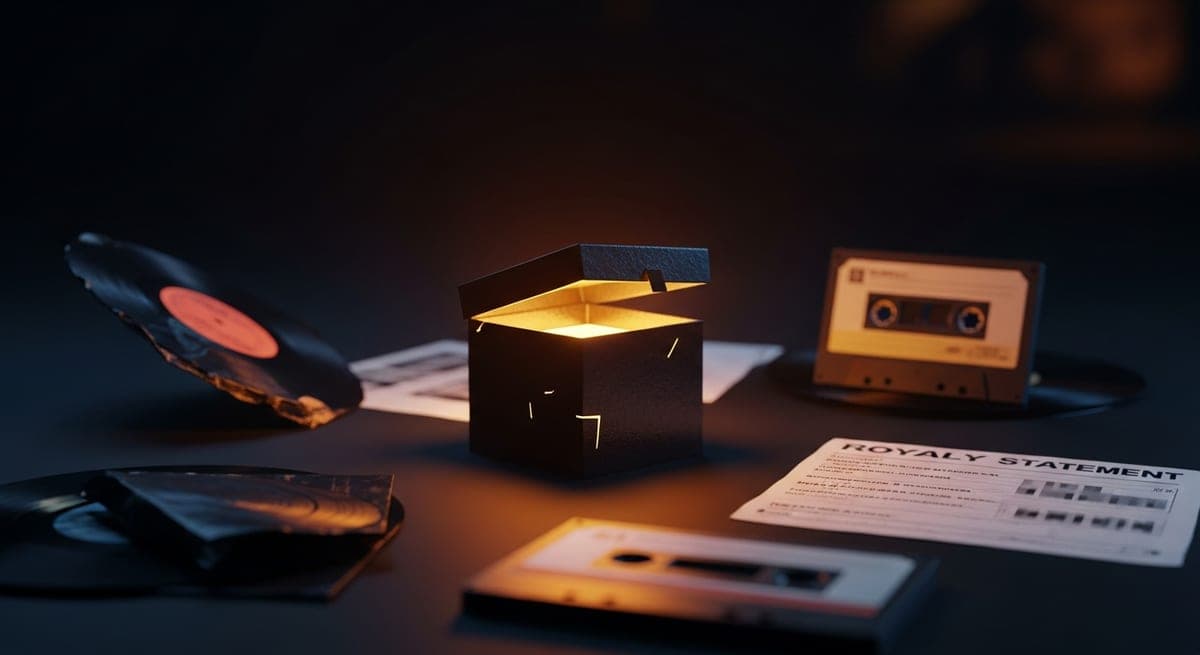
What black box royalties are
Black box royalties (also called unmatched or undistributed royalties) are music royalties that a collecting society - PRS, MCPS, PPL, or their international counterparts - has received but cannot pay out because they cannot identify the correct rights holder. The money is real and has been collected. It simply cannot be directed to the right person because the information connecting the usage event to the composition owner is incomplete or incorrect.
Why they accumulate
Every royalty payment requires a chain of matched data: the platform or broadcaster reports a usage (usually identified by ISRC or ISWC), the collecting society matches that identifier to a registered work, and then distributes the royalty to the registered rights holders. The chain breaks at several common points:
- The ISRC is correct but the composition is not registered at PRS, so no work record exists to match against.
- The ISRC exists at PRS but the ISWC is missing or wrong, preventing international matching.
- The work is registered but with incorrect or incomplete co-writer splits, so the unallocated portion sits unclaimed.
- The work is registered under a different title or a transliteration, preventing the match against foreign-language usage reports.
- The artist name on the registration does not match the name used on the release, causing the society's matching algorithm to fail.
How much sits in the black box
The IFPI's Global Music Report estimates that several hundred million dollars of royalties go unclaimed annually. At the PRO level, estimates for undistributed royalties held by collecting societies globally have ranged from £1.5 billion to £2.5 billion in various years. These figures include royalties that will eventually be redistributed, not permanently lost - but the redistribution does not go back to the original artist. It goes to the wider registered membership pool, weighted by market share. The practical consequence is that larger registered publishers and writers receive a bonus payment from others' uncollected income, while the unregistered or incorrectly registered artist receives nothing.
What happens to unclaimed royalties at PRS
PRS holds unmatched royalties for a defined period - typically three years for international income and varying periods for domestic income, depending on the category. After this holding period, the royalties are distributed to current PRS members on a market-share basis. They are not retained by PRS or returned to the broadcaster. This means that if your music has generated PRS royalties that could not be matched to your registration, those royalties have likely already been redistributed to other members. The window to claim them is finite and often shorter than artists realise.
How to check if you have unclaimed royalties
You cannot directly query the black box pool. But you can take steps to identify and recover unclaimed income:
- Log into your PRS member account and check your registered works list. Confirm every composition you have released has a corresponding PRS registration with the correct ISWC.
- Cross-reference your PRS registrations against your ISRC list. Every ISRC should link to a PRS-registered work. Gaps indicate royalties that cannot be matched.
- Review your PRS statements for usage categories that are missing or unexpectedly low. If you had radio airplay in a specific quarter and no PRS income arrived 12 to 18 months later, the usage may be sitting unmatched.
- Contact PRS member services and request a works registration audit if you suspect specific usages are not being matched.
The metadata fix
Most black box accumulation is preventable at the point of release. The key steps are: register every composition with PRS before the release date (not after); ensure the ISWC is assigned and matches your ISRC; confirm co-writer splits are accurate to the decimal point; use consistent artist and composer name spellings across all platforms and registrations. Correcting these issues after the fact recovers some income, but the earlier in a release cycle the metadata is clean, the more income flows correctly from the start.
Code Group Music's catalog assessment reviews your current PRS registrations, ISRC records, and distribution metadata to identify where your royalties may be sitting unmatched. Start at codegroupmusic.co.uk/#catalog-assessment.
Frequently Asked Questions
Can I claim black box royalties that are already in the pool?
Once PRS has redistributed unmatched royalties to the general membership pool, those specific payments cannot be reclaimed. However, registering your works correctly now ensures that future royalties from the same compositions are correctly attributed. Some historical income may still be within the holding period and recoverable with a correct registration.
Does every artist contribute to the black box?
Any artist whose music generates royalties but whose compositions are incorrectly registered (or unregistered) contributes to the unmatched pool. This is very common for self-releasing artists who register with their distributor but never register the compositions with PRS.
Are streaming royalties in the black box?
Yes. Streaming generates both performance royalties (collected by PRS) and mechanical royalties (collected by MCPS). Both can accumulate unmatched if the composition is not correctly registered. The scale of unmatched streaming royalties has grown significantly as streaming volumes have increased.
Published