
The five income streams every worship songwriter should know
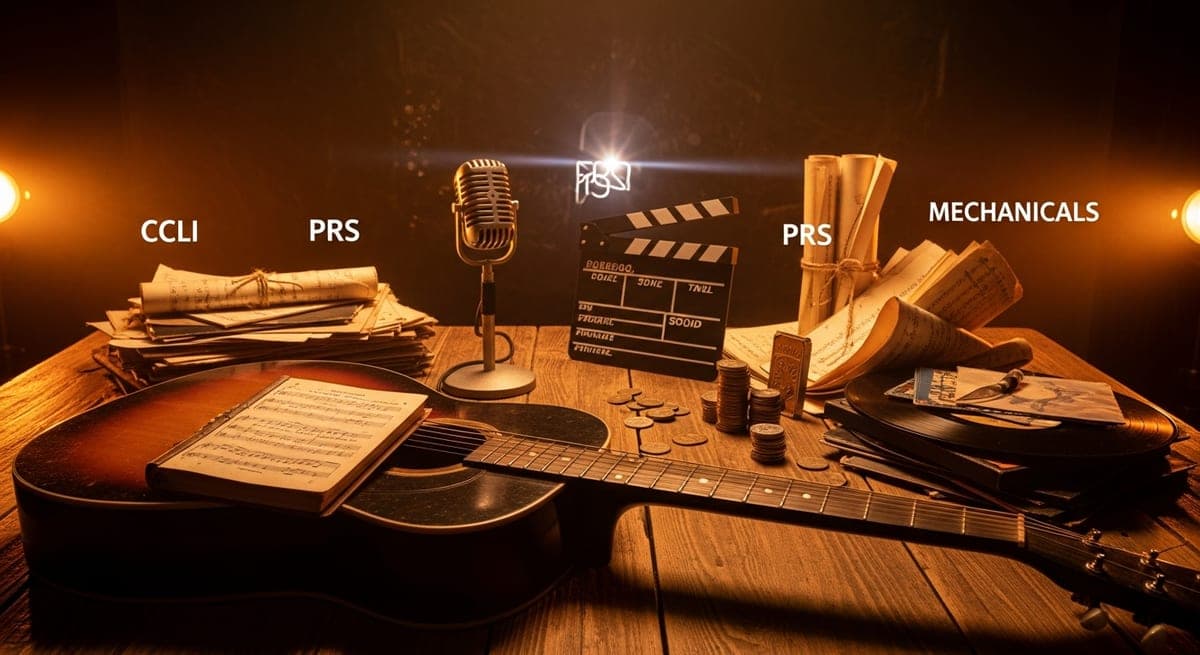
A worship songwriter who has written commercially released songs and whose music is used regularly in UK churches has five distinct royalty streams available to them. Most collect from only one or two, leaving the others entirely uncollected. The five streams are: CCLI church licensing income, PRS performance royalties from broadcasting and streaming, MCPS mechanical royalties from streaming reproduction, PPL neighbouring rights royalties from recording broadcast, and sync licensing fees from audiovisual placements. Each requires separate registration and operates independently of the others. They are additive, not alternative.
CCLI income: what it is and what it pays
CCLI (Christian Copyright Licensing International) administers blanket licences that allow churches to reproduce and perform copyrighted worship songs in their services. The licence fee - paid annually by the church based on average weekly attendance - is pooled and distributed to registered songwriters and publishers based on reported song usage. CCLI does not publish a standard per-use rate because distributions vary based on the total licence pool size, the number of registered songs, and the weighting of usage reports. In broad terms, songs that appear in the CCLI Top 100 (the most-used worship songs across licensed churches worldwide) receive materially higher distributions than less-used repertoire. For a UK worship songwriter with songs in regular use across hundreds of churches, CCLI income can range from a few hundred to several thousand pounds annually depending on usage volume and catalog size.
PRS income: performance royalties from radio and streaming
PRS for Music collects performance royalties whenever your worship compositions are used outside of church services. The main sources for worship songwriters are: Christian radio (Premier Christian Radio, UCB Radio, and regional stations all pay PRS licences); BBC broadcasts when worship music appears on Songs of Praise, BBC Radio 2 Sunday programming, or BBC Radio 4 features; commercial DSP streaming (every stream on Spotify, Apple Music, Tidal, and Amazon generates a PRS performance royalty); and YouTube monetisation if your compositions appear on monetised channels. The PRS income from streaming in particular scales directly with your audience size - a worship song with consistent streaming activity generates ongoing PRS distributions every quarter. This income is entirely separate from CCLI church income.
MCPS mechanical royalties from streaming
Every stream of a commercial worship recording generates both a performance royalty (collected by PRS) and a mechanical royalty (collected by MCPS). MCPS operates under the PRS for Music umbrella and collects mechanical royalties from DSPs who hold blanket MCPS licences covering UK streaming. For worship songwriters, MCPS income is collected automatically if your compositions are correctly registered with PRS and your distributor has completed a properly formatted delivery with your ISWC codes embedded. The mechanical royalty is typically a smaller portion of the total streaming royalty than the performance royalty, but it is real income that requires no additional action beyond correct registration.
PPL neighbouring rights from recording broadcast
PPL collects royalties for performers and record labels when recordings are broadcast or played publicly. For a worship artist who performed on and/or owns the master recording of their own compositions, PPL income from broadcast on Christian radio, BBC programmes, and commercial premises adds a third royalty stream from the same broadcast event that also generates CCLI income (church use) and PRS income (composition). PPL income is often the least-claimed royalty stream for Christian artists because the connection between recording ownership and neighbouring rights is less intuitively obvious than composition ownership and PRO registration.
Sync licensing for worship music
Worship songs are placed in audiovisual content more frequently than most worship artists realise. BBC documentary content, Christian broadcast programmes, church campaign videos, and Christian streaming platforms all licence worship songs for use. Each placement generates a sync fee (a one-off payment negotiated between the rights holder and the production company) and a subsequent performing rights tail if the content is broadcast. The BBC in particular is a significant licensor of worship music for its Songs of Praise and associated output. Worship artists can pursue sync placements directly, via a publisher with a sync team, or via specialist Christian sync agencies.
A worked example: one worship song, five income streams
Consider a UK worship songwriter who writes a song used in church services, releases it commercially, and receives BBC Radio 2 airplay. The five income streams from that single song over one year:
- CCLI: the song is reported by 300 UK churches as a regularly used worship song. CCLI distributes a portion of those churches' licence fees to the songwriter based on usage weighting.
- PRS performance: the BBC Radio 2 airplay generates a PRS broadcast royalty (BBC pays blanket PRS licensing fees). DSP streams of the commercial release generate a quarterly PRS streaming distribution.
- MCPS mechanical: the DSP streams generate a simultaneous MCPS mechanical royalty, distributed quarterly alongside the PRS performance royalty.
- PPL neighbouring rights: the BBC Radio 2 broadcast generates a PPL royalty for the performer and/or recording rights holder. Christian radio airplay generates additional PPL distributions twice yearly.
- Sync: if the song is used in a BBC Songs of Praise episode, a sync fee is negotiated and paid once. If the episode is rebroadcast, a PRS performing rights tail follows.
What worship songwriters with established catalogs are typically missing
When we audit worship songwriter catalogs, the most consistent gaps are: CCLI registration without PRS (or vice versa), PPL not registered for performer rights, ISWC codes missing from PRS registrations (preventing international royalty matching), and old compositions written before PRS membership that were never retroactively registered. All of these represent real, quantifiable income being left uncollected.
Code Group Music administers publishing rights for Christian artists and worship songwriters, covering PRS, MCPS, PPL, and CCLI coordination. Our free catalog assessment identifies your specific gaps. Start at codegroupmusic.co.uk/#catalog-assessment.
Frequently Asked Questions
Do worship songs on YouTube generate PRS royalties?
Yes, if the YouTube channel is monetised and the compositions are registered with PRS. YouTube pays royalties to PRS via a licensing agreement. PRS distributes to registered songwriters quarterly. Additionally, if you own the recording, YouTube ContentID can generate recording royalties separately.
Can I get backdated CCLI income for songs used before I registered?
CCLI distributes based on current reporting periods. You cannot retroactively claim income from periods before your songs were registered in SongSelect. This is a strong argument for registering songs with CCLI at the point of commercial release, not years later.
How does CCLI decide how much to pay each songwriter?
CCLI distributes licence fee income based on reported song usage. Churches submit usage reports (or CCLI samples usage from reporting churches). Songs with higher reported usage receive a proportionally larger share of the licence pool. Songs in the CCLI Top 100 worldwide receive significantly higher distributions than less-used repertoire.
Is there a minimum number of churches using my songs before CCLI pays me?
CCLI does not publish a minimum usage threshold for payment. However, distributions are weighted by usage, so songs with very low reported usage generate correspondingly small distributions. Registering ensures you are in the system and collecting whatever you are owed, regardless of volume.
Published