
The three systems, briefly
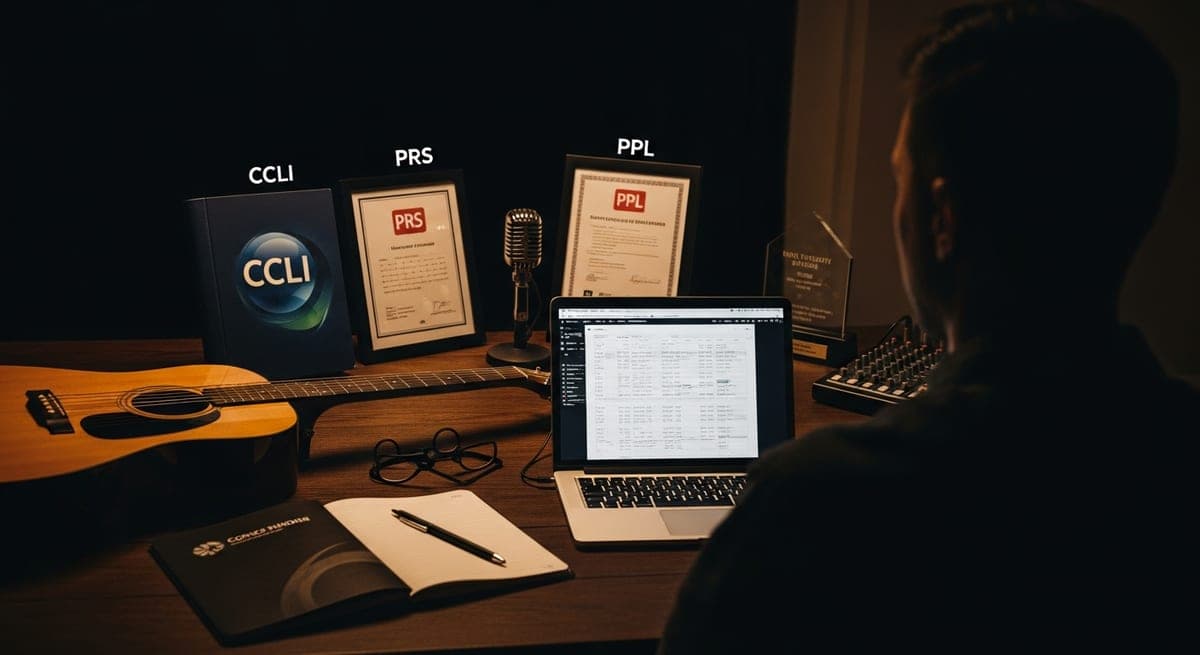
UK worship songwriters are the only category of artist who routinely interact with three separate rights administration systems: CCLI (Christian Copyright Licensing International), PRS for Music, and PPL. Each covers a distinct income stream. CCLI licenses churches to use copyrighted worship songs in services and collects a portion of those licence fees for distribution to registered songwriters. PRS for Music collects performance royalties when music is broadcast, streamed, or performed in licensed non-church venues. PPL collects neighbouring rights royalties for performers and record labels when recordings are broadcast or played publicly. For a worship songwriter who wrote, published, and recorded their own music, all three systems are simultaneously relevant.
What CCLI is and what it covers
CCLI (Christian Copyright Licensing International) operates the Church Copyright Licence, which allows churches to reproduce and perform copyrighted worship songs in their services without obtaining individual permissions from rights holders. Churches pay an annual licence fee to CCLI based on their size (average weekly attendance). CCLI collects these fees and distributes a portion to the songwriters and publishers of the songs that churches report using. The distribution mechanism is the CCLI report: churches submit song usage data to CCLI (or CCLI samples usage data from reporting churches), which it uses to weight distributions to registered rights holders. CCLI does not cover: broadcasting or streaming of worship services to external audiences, recordings released commercially on DSPs, or performances outside of church services.
What PRS for Music covers for worship songwriters
PRS for Music collects performance royalties in every context outside of church services. This includes: broadcast of worship music on radio and television (BBC Radio 2 and Radio 4, Premier Christian Radio, UCB, and regional Christian stations all pay PRS licences), streaming on commercial DSPs (Spotify, Apple Music, Amazon Music), YouTube monetisation for official channel content, live performances in licensed secular venues, sync placements in film, television, and advertising, and background music use in commercial premises. For a worship songwriter whose music appears on a major Christian album, the PRS income from radio airplay and DSP streaming can significantly exceed the CCLI income from church use. Both streams matter; neither is optional.
What PPL covers
PPL collects neighbouring rights royalties for performers and record labels. This is separate from both CCLI and PRS - it covers the recording copyright rather than the composition copyright. When a worship recording is broadcast on Christian radio, played in a commercial premises, or streamed via a public audio system, PPL collects a royalty for the performer and label who own the recording. For a worship artist who recorded their own compositions, PPL income is a third income stream running in parallel with CCLI (church use) and PRS (composition royalties). Registration with PPL is free via ppluk.com and requires adding your recordings with their ISRC codes and performer credits.
Where CCLI and PRS interact (and where they do not)
The most important distinction to understand is that CCLI and PRS cover largely non-overlapping uses. CCLI covers church services. PRS covers almost everything else. However, there are interaction points worth noting:
- Live streaming of church services: a church that streams its services online may need both a CCLI Streaming Plus licence (for the worship songs used) and a PRS licence (for the online broadcast element). The CCLI Streaming Plus licence extension was introduced specifically to address this.
- Recordings released commercially: a worship song released as a commercial track on Spotify is covered by PRS (not CCLI) for its streaming royalties. CCLI covers the church performance of that same song separately.
- Church performances by the songwriter themselves: when a worship songwriter performs their own compositions at a church service, the performance is covered by the church's CCLI licence. The CCLI distribution to the songwriter for that use flows from the church's CCLI reporting.
- Music used outside church: if a Christian song is used at a secular festival, licensed venue, or broadcast outside a church context, PRS covers it - not CCLI.
Which registrations a UK worship songwriter needs
The complete registration checklist for a UK worship songwriter:
- PRS for Music membership (prsformusic.com): covers performance and mechanical royalties from DSP streaming, radio broadcast, sync, and all non-church public performances.
- Register each composition with PRS: every worship song you have written must be individually registered with its title, co-author shares, and ISWC code.
- Register with CCLI SongSelect: add your songs to CCLI's SongSelect database so that churches using CCLI licences can legally reproduce your songs and your share of licence fees is tracked.
- Register with PPL (ppluk.com): covers neighbouring rights royalties from broadcast and public performance of your recordings.
- Register recordings with PPL: each recording must be individually registered with its ISRC code and performer credits.
- MCPS (via PRS for Music): MCPS mechanical royalties for streaming and physical reproduction are typically handled via PRS membership, but confirm your works are correctly registered on the MCPS database.
What worship songwriters most commonly miss
These are the income gaps that appear most frequently when auditing worship songwriter catalogs:
- CCLI registration only, no PRS: church use generates CCLI income but DSP streaming, radio, and sync generate nothing because PRS registration is absent.
- PRS registration without CCLI: the reverse - streaming and radio income is collected but the significant church licence pool from CCLI is unclaimed.
- No PPL registration: broadcast royalties for recordings are uncollected.
- Songs registered with CCLI but not PRS before commercial release: if a worship song becomes commercially popular before PRS registration, historic broadcast and streaming royalties cannot be recovered.
- No ISWC code: without an ISWC, international PROs cannot match uses of the composition for cross-border royalty distribution.
Code Group Music administers publishing rights for Christian artists and worship songwriters, covering PRS, MCPS, PPL, and CCLI SongSelect registration coordination. Our catalog assessment identifies which income streams you are currently missing. Start at codegroupmusic.co.uk/#catalog-assessment.
Frequently Asked Questions
Do I need both CCLI and PRS if I am a worship songwriter?
Yes. They cover different income streams and neither is a substitute for the other. CCLI covers church use of your songs. PRS covers streaming, radio broadcast, sync, and all non-church performances. A worship songwriter without both is missing income from whichever system they have not registered with.
Does my church's CCLI licence mean I get paid automatically?
Only if your songs are registered with CCLI SongSelect. CCLI distributes licence fee income to songwriters and publishers of registered songs based on church usage reports. If your song is not in SongSelect, churches can still use it under the blanket licence but you receive nothing from that use.
Can I get PRS income from worship songs played in church?
No. Church services are covered by CCLI, not PRS. PRS licences cover public performances and broadcasts outside of church services. The same song generates CCLI income from church use and PRS income from commercial DSP streaming or radio airplay - these are separate income streams, not the same royalty split two ways.
What is the CCLI Streaming Plus licence?
The CCLI Streaming Plus licence is an extension to the standard Church Copyright Licence that covers online streaming of church services. A church that livestreams its worship without a Streaming Plus licence may be infringing the copyright of the songs used, even if it has a standard CCLI licence. As a songwriter, confirming your songs are registered in SongSelect ensures you benefit from Streaming Plus distributions as well as standard CCLI distributions.
Does PPL collect royalties from Christian radio?
Yes. UK Christian radio stations - Premier Christian Radio, UCB, and regional Christian broadcasters - are PPL licensees. Broadcast of your recordings on those stations generates PPL neighbouring rights income for you as a performer and/or recording rights holder.
Published